Showing posts with label vegetables. Show all posts

Sunday, October 21, 2012

Carrot-shaped nuclei

Headache, vomiting and weakness can be the initial manifestations of medulloblastoma, the most common malignant brain tumor of childhood. The nuclei of some medulloblastomas when seen under the microscope can in shape remind you of carrots – carrot-shaped nuclei.
Medulloblastomas affect the cerebellum, a part of the brain concerned with fine-tuning movements but not initiating movements. At times medulloblastoma cells may spread to other regions via the cerebrospinal fluid, which is a clear colorless fluid surrounding the brain and spinal cord.
Surgery, radiotherapy and chemotherapy are forms of treatment for medulloblastoma.
Reference:
Kroh H, Bidziński J . Glial differentiation in medulloblastoma. Case report. Neuropatol Pol, 1993 31(1-2):75-82. Go to reference
Go to Improbable version of this post
 
Carrots, Medulloblastoma (white blob)


Friday, July 20, 2012

Sunflower cataracts

The body needs the metal copper for some of its functions such as assisting enzymes carry out their task of facilitating biochemical reactions.
In the rare inherited disease – Wilson’s disease – named after a doctor who described it, copper accumulates abnormally mainly in the liver and brain. Because of excess copper, the lens of the eye can look like a sunflower – sunflower cataracts. A cararact is cloudiness of the eye’s lens which can result from numerous causes.
Treatment for Wilson’s disease includes avoiding foods with copper, using medications which prevent absorption of dietary copper or bind to copper within the body and liver transplantation.
Reference:
Goyal V, Tripathi M. Sunflower cataract in Wilson's disease. J Neurol Neurosurg Psychiatry, 2000 69(1): 133. Go to reference

Sunflowers, eye 

Friday, July 6, 2012

Celery-stick sign

Abnormal alternating dense (sclerotic) and not so dense (lucent) bone at the ends (metaphysis) of the thigh bone (femur) and shin bone (tibia) can occur following infection of the developing baby (via an infected mother) with the rubella virus particularly during the first weeks of pregnancy.
These bands of alternating sclerotic and lucent bone are seen on radiographic - X-ray - images and they resemble celery sticks/stalks in look – celery-stick sign.
Vaccination of both females and males against the rubella virus helps prevent harmful effects of the rubella virus on the baby such as deafness, blindness, heart defects and other dreadful manifestations of the congenital rubella syndrome.
The celery-stick sign is not unique to congenital rubella.
Please also see salt and pepper retinopathy (click here).
Reference:
de Mol AC, Vrancken S, Eggink AJ, Verduyn Lunel FM, Warris A. [The first newborn with congenital rubella syndrome during the rubella epidemic in The Netherlands in 2004/'05]. Ned Tijdschr Geneeskd, 2006 150(13):741-6.
Celery, rubella virus
3D animation of rubella virus - courtesy of Martin Gardiner

Sunday, October 30, 2011

Word salad

Word salad for instance, “Colorless green ideas sleep furiously”, where phrases are grammatically correct but have no known meaning is a feature of mental illnesses such as schizophrenia and dementia. Word salad is so named to highlight the apparently random mixture of words that resembles the random mixture of vegetables, fruits, meats, etc. in a salad - word salad.
Schizophrenia is a psychiatric disorder that is difficult to define and describe, however some of its features include delusions, hallucinations and interference with speech and thinking which lead to significant social and occupational dysfunction. Delusions are fixed false firm beliefs unaltered by evidence to the contrary e.g. that everyone in the world is watching one; a hallucination is perception without a stimulus e.g. hearing voices of dead people giving one instructions; interference with speech and thinking e.g. word salad.
Dementia is not a single disease but a state characterized by overall impairment of intellect, memory and personality without loss of conscious that can be caused for example by infection, trauma, toxins, cancer, and so on.
Noam Chomsky (born 1928) an American intellectual originated the above quoted sentence for illustrative purposes.
Reference:
Portnoff LA. Schizophrenia and semantic aphasia: a clinical comparison. Int J Neuroscience, 1982 16(3-4):189-97. Go to reference

Salad

Friday, August 5, 2011

Red as a beet

Processes important for life such as sexual arousal, salivation, lacrimation (tearing), urination, digestion, defecation (passing stool) - remembered by the mnemonic SSLUDD - are largely regulated automatically and involuntarily by the parasympathetic nervous system (PSNS).
The drug atropine blocks some of the activities of the PSNS by interacting with muscarinic receptors, which are the main receptors targeted in tissues regulated by the PSNS.
Atropine overdose causes hot dry skin due to reduced sweating, red skin due to blood vessel dilatation, dryness from reduced tearing and sweating, visual disturbance because of pupillary dilatation as well as inability to focus and confusion due to effects on the brain. These changes may be summarized as, ‘hot as a hare, red as a beet, dry as a bone, blind as a bat and mad as a hatter’.
Control of the aforementioned processes and others also involves the sympathetic nervous system (SNS) which along with the PSNS by and large constitutes the autonomic nervous system.
Reference:
Ramjan KA, Williams AJ, Isbister GK, Elliot EJ: 'Red as a beet and blind as a bat' Anticholinergic delirium in adolescents: lessons for the paediatrician. J Paediatr Child Health, 2007 43(11):779-80. Go to reference

Autonomic nervous system: PSNS = blue, SNS = red
Atropine
 

Friday, July 15, 2011

Cauliflower ear

The elastic cartilage of the ear lacks blood vessels; instead, it relies on the adjacent perichondrium (layer of tissue surrounding cartilage), which contains blood vessels, for its nourishment.
Physical trauma to the ear from activities such as boxing, rugby, etc., cause blood to accumulate between the cartilage and the perichondrium. Consequently, the underlying cartilage is deprived of its nourishment and overtime new cartilage regenerates from the perichondrium in an irregular manner.
The end result is an enlarged, protruding and irregular ear that resembles a cauliflower – cauliflower ear.
Reference:
Macdonald DJM, Calder N, Perrett G, McGuiness RG: Case presentation: a novel way of treating acute cauliflower ear in a professional rugby player. Br J Sports Med, 2005 39(6): e29. Go to reference

Cauliflower ear 

Thursday, June 16, 2011

Cauliflower warts


There are several types of human papilloma viruses (HPVs), some of which are transmitted by sexual contact. Certain types of HPVs, for example type 6 and 11 cause genital warts (condyloma acuminata), which may look like cauliflowers - cauliflower warts.
Vaccination with an HPV vaccine around the time of adolescence before the onset of sexual activity may prevent genital warts.
Warts caused by HPVs other than type 6 and 11 can be spread by methods such as skin to skin contact and these warts can affect other regions of the body besides the genital and anal areas.
Reference:
Wen YC, Wu HH, Chen KK: Pan-urethral Wart Treated with 5-Fluorouracil Intraurethral Instillation. J Chin Med Assoc, 2006 69(8):391-392. Go to reference

Genital warts in a male and female

Friday, April 22, 2011

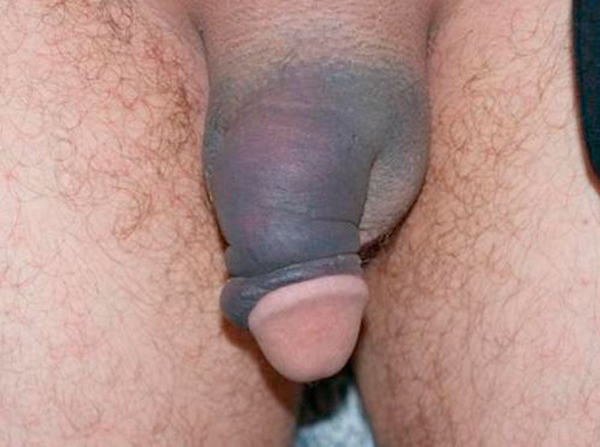
Eggplant deformity


Although the penis does not contain bone (or cartilage), it can be fractured when subjected to trauma, for example, during sexual activity. The fracture/tear occurs in the tunica albuginea, a thin envelope surrounding the corpora carvenosa. During penile erection, blood engorges the corpora cavernosa which are cylindrical pairs of erectile tissue. A tear of the tunica albuginea may be accompanied by a cracking/popping/snapping sound, pain, immediate loss of the erection, penile swelling and reddening – the fractured penis resembles an eggplant in appearance – eggplant deformity. Though penile fracture is rare, it is a medical emergency requiring surgery.
References:
Tiwary SK, Singh MK, Khanna R, Khanna AK: Penile fracture presenting as eggplant deformity. Kathmandu Univ Med J (KUMJ), 2006 4(2):249-50. Go to reference
Ozcan S, Akpinar E. Diagnosis of penile fracture in primary care: a case report. Cases J, 2009 30;2:8065. Go to reference

Penile fracture, human penis